
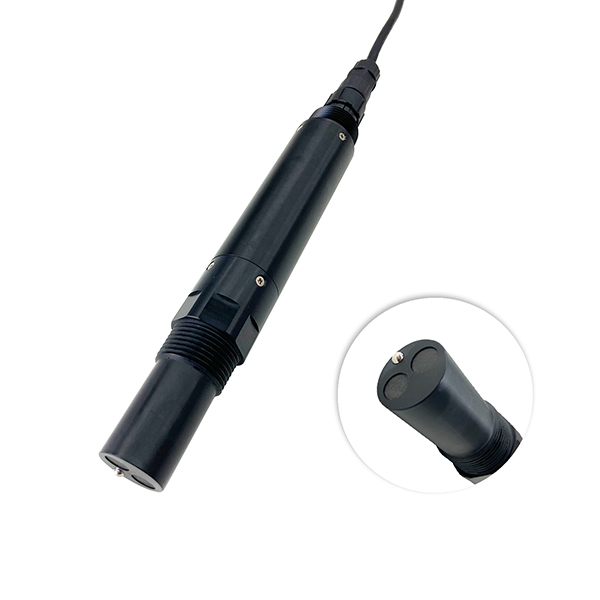

Our advanced water conductivity sensor is engineered for continuous, accurate measurement in a wide range of environments. With its digital RS-485 output using the standard Modbus RTU protocol, it simplifies connection to modern control systems, providing critical water quality data for process control, compliance, and safety.
Key Features
Dual Parameter Output: Simultaneously measures and outputs both Electrical Conductivity (EC) and Total Dissolved Solids (TDS).
Digital Communication: RS-485 interface with Modbus RTU protocol for excellent noise immunity and easy integration with PLCs, DCS, SCADA systems, touchscreens, and data loggers.
Rugged Construction: IP68 waterproof rating ensures complete protection against prolonged immersion, making it ideal for harsh or submerged environments.
Easy Installation: Features a 3/4" NPT pipe thread for simple submersion installation or direct mounting into pipelines, tanks, and vessels.
Wide Measurement Ranges: Selectable ranges (0–20 µS/cm and 0–200 µS/cm) are perfect for monitoring from pure waters to various supply waters.
Understanding EC and TDS
What is Electrical Conductivity (EC)?
Electrical Conductivity is a measure of water's ability to conduct an electric current. This ability is directly related to the concentration of ions (such as salts, minerals, and inorganic compounds) dissolved in the water. Pure, distilled water has very low conductivity, while water with more dissolved ions has higher conductivity. It is reported in microsiemens per centimeter (µS/cm) or millisiemens per centimeter (mS/cm).
What is Total Dissolved Solids (TDS)?
TDS represents the total concentration of all inorganic and organic substances dissolved in water, typically expressed in parts per million (ppm) or milligrams per liter (mg/L). These can include minerals, salts, metals, cations, and anions.
The Relationship Between EC and TDS
TDS is empirically derived from the Electrical Conductivity measurement. Since dissolved ions conduct electricity, a higher EC value generally corresponds to a higher TDS value. The sensor calculates TDS using a conversion factor (usually between 0.5 and 0.7) applied to the EC reading. This provides a convenient estimate of the dissolved solids content without requiring a separate, complex analysis.
In short: EC is a direct measurementof ionic content, while TDS is a calculated valuederived from EC to estimate the mass of dissolved solids.
Model | BGT-WEC(K) water EC sensor | |||||
Measuring range | 0~20.00 μS/cm | 0~200.00 μS/cm | 0~5000.00 μS/cm | 0~200.0 mS/cm | 0~400 mS/cm | |
Resolution | 0.01μS | 0.1μS | 1μS | 0.1mS | 0.1mS | |
Precision | ±1.5%F.S. | |||||
Working temperature | 0~65℃ | |||||
Working pressure | <0.6MPa | |||||
Power supply | 12~24VDC ±10% | |||||
Signal output | RS-485(Modbus/RTU)(Customized 4-20mA,RS485 Modbus and 4-20mA dual output) | |||||
Wetted material | ABS/SUS316L(Default)/PVC | |||||
Mounting method | Immersion mounting, 3/4 NPT thread | |||||
Cable length | 5 meters, other lengths can be customized | |||||
Temperature compensation | Auto temperature compensation(Pt1000) | |||||
Calibration | Two-point calibration | |||||
Power consumption | <0.3W@12V | |||||
Protection grade | IP68 | |||||
A water EC sensor is a device used to measure the electrical conductivity (EC) of water, which reflects how well the water can conduct an electric current. Since conductivity depends on the concentration of dissolved salts, minerals, and ions (like sodium, chloride, calcium, magnesium), EC is commonly used as an indicator of water quality.
How it works
The sensor has two or more electrodes that apply a small electrical voltage through the water.
Ions in the water carry the current between electrodes.
The more dissolved ions there are, the higher the conductivity (EC value).
What EC tells you
High EC = more dissolved salts/minerals (water may be hard, saline, or polluted).
Low EC = purer water with fewer ions (like distilled or deionized water).
EC itself doesn’t identify which ions are present, just their overall concentration.
Units
Measured in µS/cm (microsiemens per centimeter) or mS/cm (millisiemens per centimeter).
Often correlated with TDS (Total Dissolved Solids) in ppm.
EC Ranges for Pure Water(pure water conductivity)
Ultra-pure water: ~0.055 µS/cm
Practical lab DI/distilled water: ~0.1 – 3 µS/cm
Applications
Agriculture: Monitoring soil or irrigation water salinity to prevent crop damage.
Aquaculture: Ensuring proper mineral balance for fish/shrimp health.
Drinking water supply: Checking for contamination or excessive mineral content.
Industrial water treatment: Monitoring boiler water, cooling water, or wastewater.
Environmental monitoring: Measuring river, lake, or groundwater quality.
Featuring submersible installation with a 3/4 NPT thread, the sensor is easy to mount in pipelines, tanks, or immersion setups. With an IP68 protection rating, it is highly resistant to harsh environments, ensuring stable long-term performance.
The sensor provides dual outputs for conductivity and TDS across two selectable ranges: 0–20 μS/cm and 0–200 μS/cm, making it a versatile tool for precise water quality monitoring in both municipal and industrial systems.