

Types of Wind SensorsWind Speed Sensor (Anemometer)
Measures the velocity of wind.
Common types: Cup anemometers, ultrasonic, propeller-type.
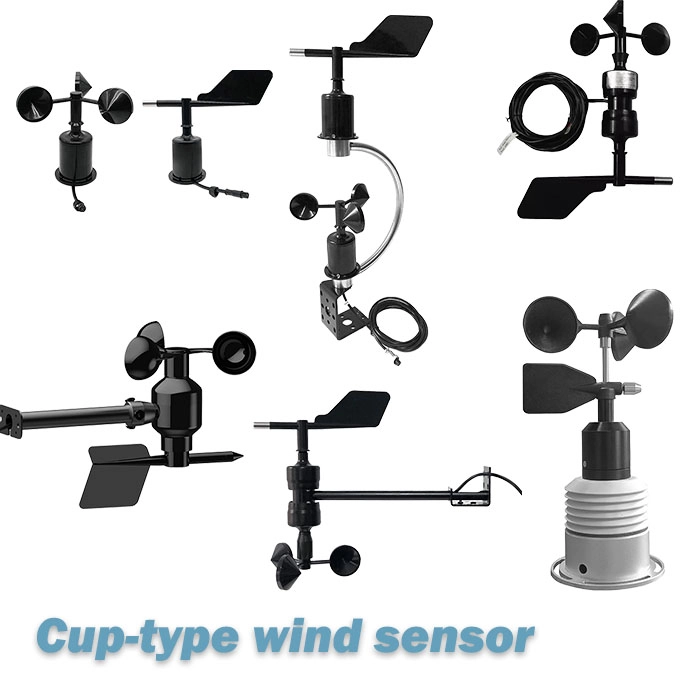
Mini type three cup anemometers is used cup wind as sensing components, which is rotated by wind and drives magnetic steel, the reed switch is working by magnetic steel sensing, output relative electric pulse signals. It's applied in meteorological stations, environmental protection, traffic areas and so on.
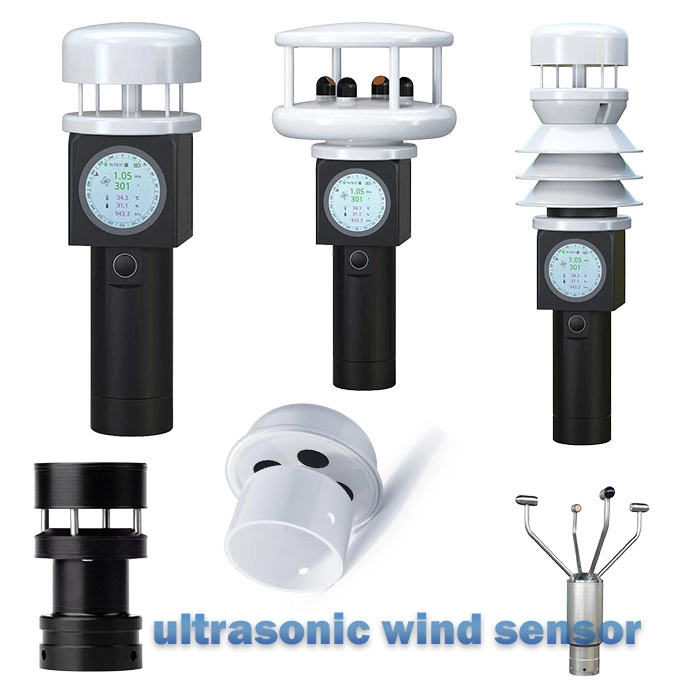
An ultrasonic wind sensor is a solid-state device that measures wind speed and direction using ultrasonic sound waves. It contains no moving parts, making it highly durable and maintenance-free.
A propeller-type wind sensor (mechanical anemometer) measures wind speed and direction using a rotating propeller and a wind vane. It is a traditional and widely used sensor with mechanical components.
Wind Direction Sensor
Measures the direction from which the wind is blowing.
Typically vane-type or ultrasonic.
Combined Wind Speed & Direction Sensor
Measures both parameters in one device.
Often used in compact weather stations and IoT applications.
Output Signal Options
RS485 (Modbus RTU): Stable and long-distance data transmission.
Analog (0–5V, 4–20mA): Compatible with PLCs and standard controllers.
Digital Display: Visual, real-time monitoring on-site.
Wind Speed Sensor (Anemometer)
Measures the velocity of wind.
Common types: Cup anemometers, ultrasonic, propeller-type.
Mini type three cup anemometers is used cup wind as sensing components, which is rotated by wind and drives magnetic steel, the reed switch is working by magnetic steel sensing, output relative electric pulse signals. It's applied in meteorological stations, environmental protection, traffic areas and so on.
An ultrasonic wind sensor is a solid-state device that measures wind speed and direction using ultrasonic sound waves. It contains no moving parts, making it highly durable and maintenance-free.
A propeller-type wind sensor (mechanical anemometer) measures wind speed and direction using a rotating propeller and a wind vane. It is a traditional and widely used sensor with mechanical components.
Wind Direction Sensor
Measures the direction from which the wind is blowing.
Typically vane-type or ultrasonic.
Combined Wind Speed & Direction Sensor
Measures both parameters in one device.
Often used in compact weather stations and IoT applications.
Output Signal Options
RS485 (Modbus RTU): Stable and long-distance data transmission.
Analog (0–5V, 4–20mA): Compatible with PLCs and standard controllers.
Digital Display: Visual, real-time monitoring on-site.
Key Differences Between Wind Sensor Types
Feature | Cup Anemometer | Ultrasonic Wind Sensor | Propeller-Type Wind Sensor |
|---|---|---|---|
Measurement Principle | Cup rotation speed | Ultrasonic time-of-flight | Propeller RPM + vane direction |
Moving Parts | Yes (bearings, cups) | No | Yes (propeller, bearings) |
Accuracy | Medium (±0.3–0.5 m/s) | High (±0.1 m/s, ±1°) | Medium (±0.3 m/s, ±5°) |
Response Time | Slow (1–3 s) | Very fast (10+ Hz) | Moderate (1–2 s) |
Low-Wind Performance | Poor (threshold ~0.5 m/s) | Excellent (≥0.01 m/s) | Fair (threshold ~0.3 m/s) |
Harsh Environment | Excellent (dust, rain) | Vulnerable (icing, rain) | Moderate (needs protection) |
Maintenance | Bearing lubrication | None | Propeller cleaning |
Cost | Low (100–1,000) | High (1,000–10,000) | Medium (500–2,000) |
Lifespan | 5–10 years (with upkeep) | 10+ years | 5–8 years (with upkeep) |
2. How to Choose the Right Wind Sensor?
(1) Based on Measurement Needs
High precision/fast response → Ultrasonic sensor
Best for: Wind turbine control, turbulence research, airport wind shear detection.
Routine monitoring/low cost → Cup anemometer
Best for: Weather stations, agriculture, structural wind load monitoring.
Combined speed + direction → Propeller-type or ultrasonic
Propeller: Budget-friendly. Ultrasonic: High-end applications.
(2) Environmental Considerations
Extreme weather (dust, storms) → Cup anemometer
Robust mechanical design withstands abuse.
Icing conditions → Ultrasonic (heated) or cup (winterized)
Marine/corrosive environments → Cup (stainless steel) or ultrasonic (salt-proof coating)
(3) Budget & Maintenance
Low budget/accept maintenance → Cup or propeller-type
Zero maintenance/long-term use → Ultrasonic
3. Recommended Applications
Scenario | Recommended Sensor | Why? |
|---|---|---|
Permanent weather stations | Cup anemometer | Cost-effective, durable |
Wind turbine control | Ultrasonic sensor | High accuracy, fast response |
Ships/offshore platforms | Cup anemometer (marine-grade) | Resists salt spray |
Agricultural microclimate | Propeller-type or cup | Balanced price/performance |
Skyscraper wind load studies | Ultrasonic sensor | No mechanical lag |
Dust/sandstorm monitoring | Cup anemometer | Unaffected by airborne debris |
4. Pitfalls to Avoid
Avoid ultrasonic sensors in cluttered environments (trees, buildings) due to signal reflection errors.
Avoid cup anemometers for turbulence studies—mechanical inertia delays readings.
Avoid propeller-types in icy conditions unless heated.
5. Summary
Choose a cup anemometer for durability and low-cost outdoor deployments.
Choose an ultrasonic sensor for lab-grade precision and maintenance-free operation.
Choose a propeller-type for moderate budgets needing combined speed/direction data.
Decision factors: Prioritize accuracy, environment, budget, and maintenanceto select the optimal sensor.