
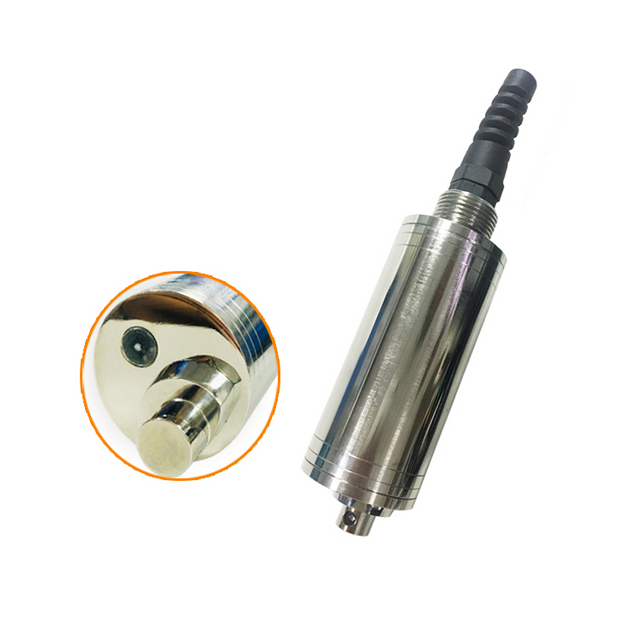

Description:
A turbidity sensor is a device that measures how cloudy or hazy a liquid is, which is caused by suspended particles such as silt, algae, organic matter, or other solids.
It essentially determines how much light is scattered when a beam passes through the water — the cloudier the water, the higher the turbidity.
BGT-WTB integrated online turbidity sensor is designed and manufactured using the principle of scattered light turbidity measurement. When a beam of light is incident on a water sample, the light is scattered by the turbidity substance in the water sample, and the intensity of the scattered light in the direction perpendicular to the incident light is measured and compared with the internal calibration value to calculate the turbidity in the water sample. Degree, linearized to output the final value.
Measuring principle | Light scattering method |
Measuring range | 0~100NTU or 0~1000NTU |
Resolution | 0.01NTU, 0.1°C |
Accuracy | ±3% or ≤±3NTU, is subject to the larger, ±0.5°C |
Calibration methods | Two-point calibration |
Temperature compensation | Automatic temperature compensation (Pt1000) |
output method | RS485 Modbus-RTU |
Working conditions | 0~50°C, <0.2MPa |
Storage temperature | -5°C~65°C |
Mounting | Immersion installation |
Power | 0.1W@12V |
Power supply | 12~24VDC |
Protection class | IP68 |
Main Application Areas
Turbidity sensors are widely used in water quality monitoring and process control:
Drinking Water Treatment
Monitor sediment removal efficiency.
Ensure clarity meets WHO or EPA standards (<1 NTU for treated water).
Wastewater Treatment
Check settling tank performance.
Control sludge discharge and filtration systems.
Environmental Monitoring
Measure river, lake, or reservoir turbidity for ecological health.
Track sediment levels after heavy rains or construction.
Industrial Processes
In beverage production (beer, juice) to ensure product clarity.
In paper/pulp industry to monitor suspended solids in process water.
Aquaculture
Maintain optimal water clarity for fish/shrimp health.