
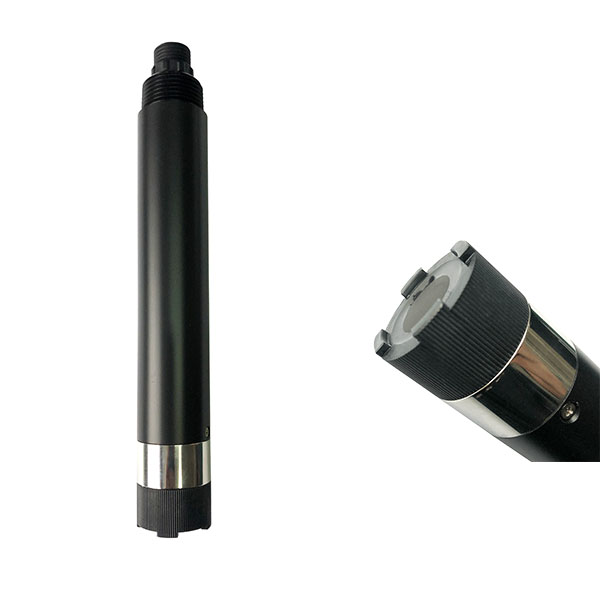

◀◀ Key Selling Points ▶▶
Dissolved oxygen (DO) sensors are critical for measuring the amount of oxygen available in water, which is essential for aquatic life, industrial processes, and environmental protection. Below are the key application scenarios for DO sensors:
*Without electrolyte, the polarization will not
*Without consuming oxygen, without affecting the flow rate
*Built-in temperature sensor, automatic temperature compensation
*Interference is not sulfide and other chemicals
*Drift is small, fast response, more accurate measurement
*Maintenance-free, long life cycle, the use of lower cost
*Fluorescent cap replacement is simple
*RS-485 interface, Modbus-RTU protocol
◀◀ Product Parameters ▶▶
Model | BGT-WDO |
Measuring principle | Fluorescence |
Measuring range | 0 ~ 20mg / L, 0~60.0 ℃ |
Resolution | 0.01mg / L, 0.1 ℃ |
Accuracy | ± 2% FS, ± 0.2 ℃ |
Temperature compensation | Automatic temperature compensation (the Pt1000) |
output method | RS-485 bus, Modbus-RTU protocol |
Working conditions | 0 ~ 45 ℃, <2bar |
storage temperature | -5 ~ 65 ℃ |
Mounting | Immersion installation |
Cable length | 5 meters, Other lengths can be customized |
Pipe thread | G3/4, M39*1.5 |
power supply | 9~30VDC |
Protection class | IP68 |
calibration | Two-point calibration |
Fluorescence lifetime cap | Guarantee for one year (normal use) |
Sensor housing material | ABS, 316L stainless steel |
◀◀ Application Scenarios ▶▶
1. Environmental & Ecological Monitoring
Rivers, Lakes, and Oceans
Assess water health and detect hypoxia (low oxygen) in ecosystems.
Monitor eutrophication (algal blooms) caused by excess nutrients.
Wetlands & Estuaries
Study oxygen fluctuations due to tides and organic decomposition.
2. Wastewater Treatment & Industrial Effluent
Activated Sludge Processes
Optimize aeration in biological treatment to reduce energy costs.
Effluent Compliance
Ensure discharged water meets regulatory DO levels (e.g., >2 mg/L for fish survival).
Anaerobic Digestion
Monitor oxygen-free conditions for biogas production.
3. Aquaculture & Fish Farming
Ponds, Tanks, and Recirculating Systems (RAS)
Maintain safe DO levels (typically 5–6 mg/L for most fish).
Prevent fish kills due to oxygen depletion (e.g., at dawn).
Transport of Live Seafood
Ensure sufficient oxygen during shipping.
4. Drinking Water & Distribution Systems
Reservoirs & Pipelines
Detect oxygen levels to prevent corrosion (low DO) or taste issues (high DO).
Groundwater Monitoring
Track DO to assess contamination risks (e.g., methane intrusion).
5. Industrial Processes
Biotech & Fermentation
Control oxygen for microbial growth (e.g., in breweries, pharmaceuticals).
Power Plant Cooling Water
Prevent corrosion in boilers and condensers.
Pulp & Paper Industry
Monitor oxygen in effluent to comply with environmental regulations.
6. Research & Education
Oceanography & Limnology
Study seasonal DO variations in deep waters ("dead zones").
Laboratory Experiments
Test BOD (Biochemical Oxygen Demand) for pollution studies.
