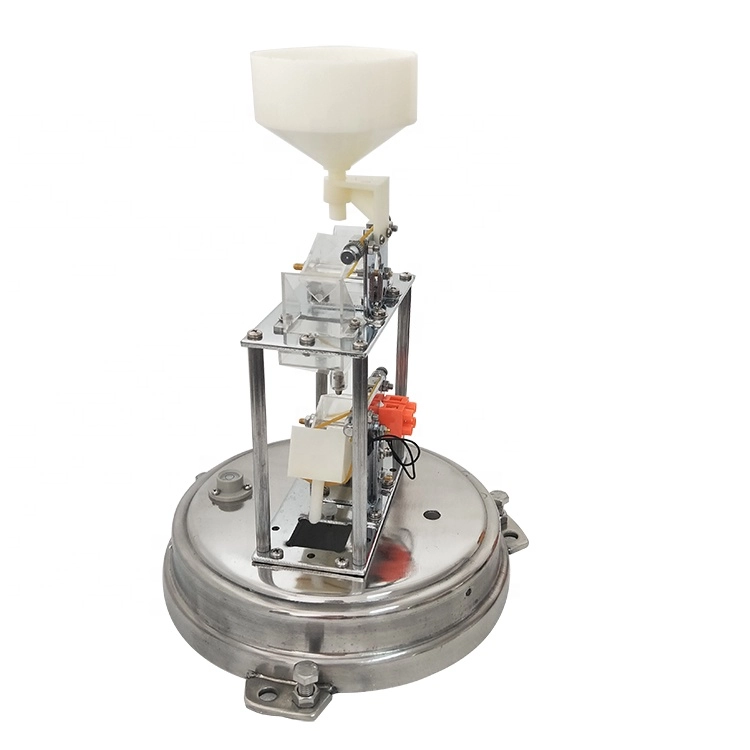

Description:
BGT-601SS Tipping Bucket Rain Gauge is a durable weather instrument for monitoring rain rate and total rainfall. It has been updated and improved with the addition of an inner funnel to even the flow of the rainfall into the gauge, providing better accuracy at higher rainfall rates. With minimal care it will provide many years of service. The rain gauge is constructed of high impact UV-protected plastic/ stainless steel to provide reliable, low-cost tipping bucket rainfall monitoring. The tipping bucket sensor mechanism activates a sealed reed switch that produces a contact closure for each 0.2 mm or 0.5mm of rainfall. The rain gauge sensor can be pole mounted or bolted to a level plate.
| Parameter | Specification |
|---|---|
| Resolution | 0.2mm |
| Accuracy | ±≤ 2% (≤1mm/min); ±≤ 3% (≤4mm/min) |
| Measuring Range | 0~4mm/min (Workable up to 8mm/min) |
| Bucket Material | Stainless Steel |
| Base Material | Polished 304 Stainless Steel |
| Inner Diameter | 200mm / 8inch (±0.3%) |
| Acute Angle of Cutting Edge | 40~45° |
| Working Environment | -10~50℃, 0%~95% RH (Non-condensing) |
| Power Supply | Pulse: Max DC24V, 100mA; RS485 (Optional): DC 7-24V |
| Output | Reed switch: 5 pulses/mm (Max DC24V, 100mA); RS485 (Optional) |
Siphon Rain Gauge
Working Principle
Float + Siphon: Rainwater collects in an inner chamber, raising a float that moves a pen to draw a curve on a rotating drum chart. When the water level reaches a set height (e.g., 10 mm), the siphon tube automatically drains the chamber, resetting the float. The pen drops vertically, marking the start of a new cycle.
Continuous recording: Produces a precipitation intensity vs. time curve on paper or a digital recorder.
Advantages
High precision: Suitable for measuring light precipitation (e.g., fog, drizzle) with resolutions up to 0.1 mm.
Continuous data: Directly records precipitation trends, allowing analysis of intensity variations.
Reduced interference: Enclosed design minimizes evaporation and wind effects.
Limitations
Higher maintenance: Requires regular replacement of chart paper and cleaning of the siphon tube to prevent clogging.
Mechanical complexity: Siphon failure or clock mechanism malfunctions may lead to data loss.
Less suitable for extreme rainfall: Heavy storms may cause rapid siphoning, reducing recording accuracy.
Typical Applications
Baseline meteorological observation stations (e.g., WMO-recommended traditional stations).
Scientific research (e.g., precipitation process analysis, climate studies).
Unattended stations requiring long-term stable records.
Further details, please contact us!
