
Drinking water/surface water/various water supplies/industrial water treatment
Signal output: Supports RS-485, ModbusRTU protocol, and 4-20mA current output
It is convenient to connect to third-party devices such as PLC, DCS, industrial control computers, general-purpose controllers, paperless recording instruments or touch screens.
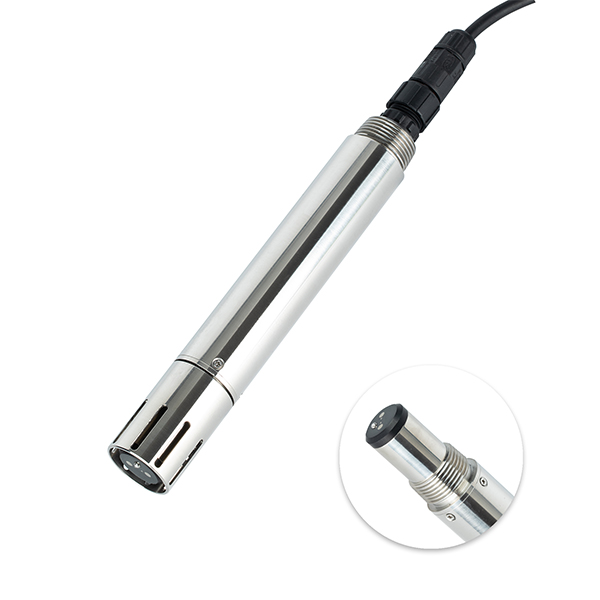
Submersible installation, with 3/4NPT thread, facilitating submersible installation or installation on pipes and tanks.
IP68 protection, within a water depth of 20 meters.
What is Electrical Conductivity (EC)?
Electrical Conductivity is a measure of water's ability to conduct electric current. You can determine the presence of ions such as salts, minerals, and inorganic compounds dissolved in the water. Pure, distilled water has very low conductivity, while water with more dissolved ions has higher conductivity.
What is Total Dissolved Solids (TDS)?
TDS is the totally dissolved solid. The solid can be minerals, salts, metals, cations, and anions.
The Relationship Between EC and TDS
TDS is empirically derived from the Electrical Conductivity measurement. Since dissolved ions conduct electricity, a higher EC value generally corresponds to a higher TDS value. The sensor calculates TDS using a conversion factor (usually between 0.5 and 0.7) applied to the EC reading. This provides a convenient estimate of the dissolved solids content without requiring a separate, complex analysis.
In short: EC is a direct measurementof ionic content, while TDS is a calculated valuederived from EC to estimate the mass of dissolved solids.
Model | BGT-WEC(K2) |
Measuring principle | Induction electrode method |
| Measuring range | 0-5000 μS/cm |
| Resolution | 1 μS/cm |
Accuracy | ±1.5%; ±0.3℃ |
Output | RS-485(Modbus RTU), 4-20 mA |
Storage temperature | -5 to 65℃ |
Working conditions | 0-60℃, ≤0.6MPa |
Shell material | 316L |
Installation method | Input type installation, 3/4NPT |
Consumption | 0.2W@12V |
Power supply | 12-24VDC |
Protection class | IP68 |
Common Application Scenarios
This versatile sensor is a critical component in numerous industries where water quality is paramount:
Drinking Water & Potable Water Treatment: Monitor the quality of source water, ensure the effectiveness of filtration and purification processes, and verify the safety of finished drinking water throughout the distribution system.
Surface Water & Environmental Monitoring: Deploy in rivers, lakes, and streams to track pollution, measure salinity intrusion, monitor agricultural runoff, and conduct long-term environmental health studies.
Various Water Supply Systems: Monitor feed water for industrial processes, irrigation water in agriculture to control salinity, and water in aquaculture to maintain healthy conditions for aquatic life.
Industrial Water Treatment:
Cooling Towers & Boiler Feedwater: Control blowdown cycles and prevent scaling and corrosion by monitoring water purity and dissolved solid concentration.
Reverse Osmosis (RO) Systems: Monitor the efficiency of RO membranes by checking the conductivity of the feed water, permeate (product water), and reject stream.
Wastewater Effluent: Verify that treated wastewater meets regulatory discharge standards before release.
Pharmaceutical & Food & Beverage Production: Ensure water used in production (e.g., CIP - Clean-in-Place, ingredient water) meets strict purity guidelines (e.g., USP Purified Water standards).