
Description:
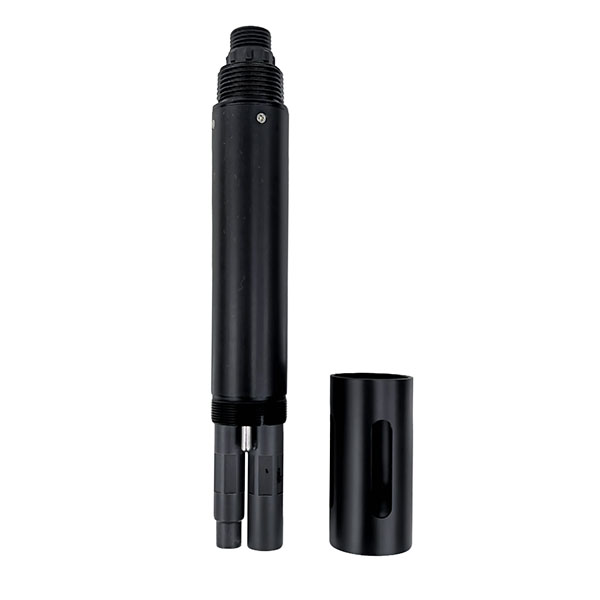
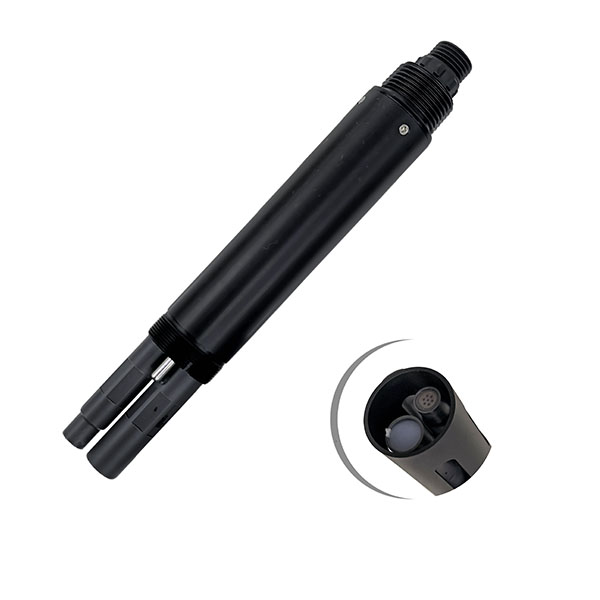
The online ammonium nitrogen sensor is designed for measuring ammonium ion (NH4⁺) concentration in water. It features built-in temperature compensation to ensure fast, simple, accurate, and cost-effective measurements.
The sensor adopts a PVC membrane-based ammonium ion selective electrode, specially designed for NH4⁺ detection. The internal reference solution slowly leaks through a microporous salt bridge under a pressure of at least 100 kPa (1 bar), providing a highly stable reference system. This design significantly extends the electrode’s service life compared with conventional industrial electrodes.
The sensor is IP68-rated and supports RS-485 (Modbus RTU) output for easy integration with PLCs, DCS, industrial PCs, general controllers, paperless recorders, or HMI touch panels.
Technical Specifications
| Item | Specification |
|---|---|
| Model | BGT-WNH4(K) |
| Housing Material | ABS, PVC, POM |
| Measuring Principle | Ion-selective electrode (ISE) method |
| Measuring Range & Resolution | • 0–10.00 mg/L, 0.01 mg/L, 0.1℃ • 0–100.00 mg/L, 0.01 mg/L, 0.1℃ • 0–1000.0 mg/L, 0.1 mg/L, 0.1℃ |
| Accuracy | • 0–10.00 mg/L: ±10% of reading or ±1 mg/L • 0–100.00 mg/L: whichever is greater, ±0.5℃ • 0–1000.0 mg/L: ±10% of reading, ±0.5℃ |
| Response Time (T90) | < 60 s |
| Lowest Detection Limit | • 0.09 (for 0–10 mg/L and 0–100 mg/L) • 0.9 (for 0–1000 mg/L) |
| Calibration Method | Two-point calibration |
| Cleaning Method | / (manual or external cleaning) |
| Temperature Compensation | Automatic (Pt1000) |
| Signal Output | RS-485 (Modbus RTU), 4–20 mA (optional) |
| Storage Temperature | -5 to 65℃ |
| Operating Conditions | 0–40℃, <0.1 MPa, pH 4–10 |
| Installation Method | Submersible installation, 3/4 NPT |
| Power Consumption | 0.2 W @ 12 V |
| Power Supply | 12–24 V DC |
| Protection Rating | IP68 |
| Cable Length | 5 m (other lengths customizable) |
Note: The sensor has been calibrated before leaving the factory. Do not calibrate it unless the measurement error is exceeded.
Key Features
High precision ammonium ion measurement using ion-selective electrode technology
Automatic temperature compensation (Pt1000) for reliable results
Extended electrode lifetime with a stable reference system
Flexible integration: RS-485 (Modbus RTU) and optional 4–20 mA output
Rugged design, IP68-rated, suitable for long-term submersible installation
Low power consumption and easy installation (3/4 NPT)
Application Scenarios of NH₄⁺ Sensor
1. Wastewater Treatment
Scenario: Monitoring ammonium nitrogen in influent and effluent of municipal and industrial wastewater plants.
Purpose: Ensures proper nitrification and denitrification processes, helps control aeration, and verifies compliance with discharge standards.
2. Surface Water & Environmental Monitoring
Scenario: Continuous monitoring in rivers, lakes, reservoirs, and groundwater.
Purpose: Detects ammonium pollution caused by agricultural runoff, sewage discharge, or industrial effluents; supports environmental protection and water quality management.
3. Drinking Water & Source Water
Scenario: Monitoring ammonium concentration in raw water sources (reservoirs, wells) and drinking water supply systems.
Purpose: Ensures water safety and compliance with drinking water quality standards.
4. Aquaculture & Fisheries
Scenario: Real-time monitoring of aquaculture ponds, fish farms, and recirculating aquaculture systems (RAS).
Purpose: Prevents toxic effects of elevated ammonium levels on fish and shrimp, optimizing growth conditions and reducing mortality.
5. Industrial Process Water
Scenario: Monitoring circulating cooling water, boiler feedwater, and chemical process effluents.
Purpose: Prevents equipment corrosion, scaling, and ensures process water quality stability.
6. Agriculture & Irrigation Water
Scenario: Measuring ammonium levels in irrigation water or runoff from fertilized fields.
Purpose: Optimizes fertilizer use, prevents excessive nutrient discharge, and reduces eutrophication risks.